

No — Dropbox is not HIPAA compliant by default.
Dropbox can only be used for HIPAA-regulated data if the organization is on an eligible plan, has a signed Business Associate Agreement (BAA), and correctly configures security controls. Even then, HIPAA compliance responsibility remains with the healthcare organization, not Dropbox.
This answer aligns with HHS guidance, Dropbox’s own documentation, and HIPAA enforcement precedent.
→ Want confirmation from a HIPAA expert—not assumptions? Talk to a compliance specialist
What HIPAA Requires From File Sharing Platforms (Not Vendor Claims)
Under the HIPAA Security Rule, any system that stores or transmits electronic protected health information (ePHI) must support administrative, technical, and physical safeguards.
According to HHS guidance, required safeguards include:
- Unique user identification and access controls
- Audit controls to record system activity
- Transmission security (e.g., TLS encryption)
- Encryption of data at rest (addressable but expected)
- A signed Business Associate Agreement (BAA) for any vendor handling PHI
→ Source: HHS – HIPAA Security Rule Guidance
HIPAA does not certify software. Compliance depends on how systems are implemented, configured, and governed.
Is Dropbox HIPAA Compliant?
The Accurate Answer
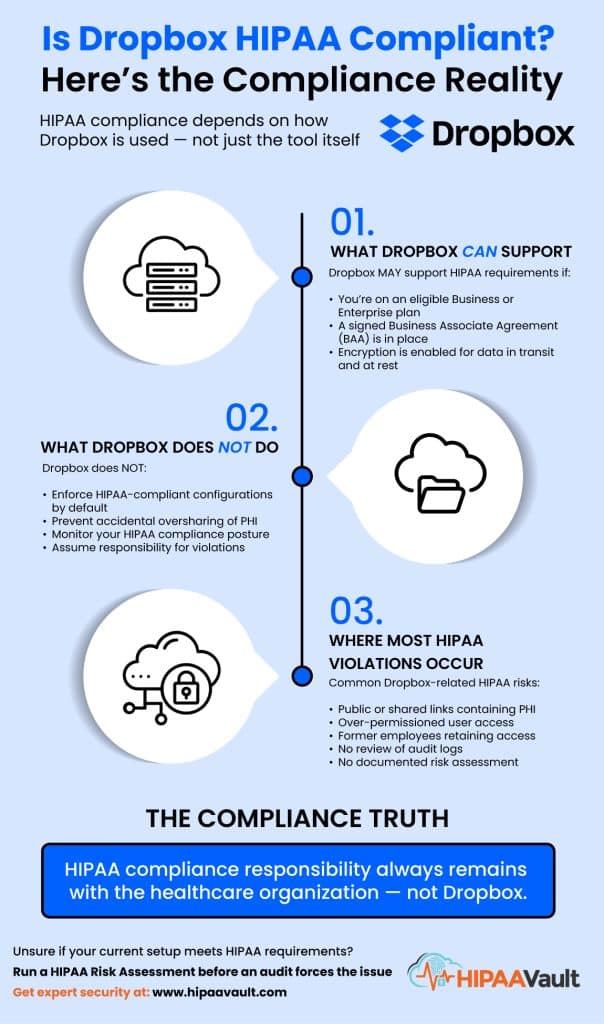
Dropbox can support HIPAA compliance — but it is not inherently HIPAA compliant.
Dropbox will sign a Business Associate Agreement (BAA) only for customers on:
- Dropbox Business Advanced
- Dropbox Enterprise
→ Without a signed BAA, Dropbox cannot legally be used to store or share PHI.
Dropbox Is HIPAA-Capable — Not HIPAA-Compliant Software
This distinction is critical and frequently misunderstood.
Dropbox provides security features, but HIPAA compliance requires enforced controls, documented processes, and ongoing risk management.
What Dropbox Provides
- Encryption in transit (TLS)
- Encryption at rest (AES-256)
- Admin access controls
- Activity logging (plan-dependent)
Dropbox aligns its encryption with NIST standards, which HHS references as acceptable safeguards.
→ Source: NIST SP 800 Series
What Dropbox Does Not Enforce
Dropbox does not:
- Enforce HIPAA-safe sharing settings by default
- Prevent PHI from being shared via public or external links
- Restrict access from unmanaged or personal devices
- Monitor PHI usage for compliance violations
- Provide healthcare-specific workflows or safeguards
Under HIPAA, the covered entity—not the cloud vendor—is responsible for correct configuration, access control, and ongoing risk management, even when a BAA is in place.
Common HIPAA Violations Caused by Dropbox Misconfiguration
OCR enforcement actions repeatedly show that misconfiguration is a leading cause of HIPAA violations, not lack of encryption.
Common Dropbox-related risk scenarios include:
- Public or unrestricted shared links containing PHI
- Former employees retaining access
- PHI synced to unencrypted local devices
- Lack of audit log review or retention
- No documented risk analysis tied to cloud usage
→ Not Sure If Dropbox Puts You at Risk? Run a HIPAA Risk Assessment
Managed Enterprise Hosting on Google Cloud Platform
Leverage the power of Google Cloud with guaranteed compliance. We manage Kubernetes, APIs, and databases for high-scale healthcare apps.
Learn MoreCan You Use Dropbox Securely for PHI?
Yes — but only if all of the following are true:
- You are on an eligible Dropbox plan
- A signed BAA is in place
- Access controls are tightly restricted
- Sharing settings are locked down
- Audit logs are actively monitored
- A documented HIPAA risk assessment supports usage
For many healthcare organizations, this requires dedicated IT and compliance oversight.
HIPAA does not allow “best effort” compliance.
HIPAA Vault vs Dropbox: Purpose-Built vs General-Purpose
| Requirement | Dropbox | HIPAA Vault |
| HIPAA by default | ❌ No | ✅ Yes |
| BAA included | ⚠️ Limited plans | ✅ Always |
| PHI-specific safeguards | ❌ No | ✅ Yes |
| Audit-ready logging | ⚠️ Manual | ✅ Built-in |
| Managed security | ❌ No | ✅ 24/7 |
| Compliance support | ❌ Limited | ✅ HIPAA experts |
HIPAA Vault is designed specifically for HIPAA-compliant file sharing, not adapted from consumer cloud storage.
→Move PHI to a Platform Designed for HIPAA — Not Adapted to It
When Healthcare Organizations Should Avoid Dropbox
Dropbox is not recommended if your organization:
- Shares PHI with external providers or labs
- Lacks internal HIPAA security expertise
- Needs audit-ready documentation
- Wants reduced compliance liability
- Handles recurring or automated PHI workflows
In these cases, HIPAA-built infrastructure significantly reduces risk.
→Stop Risky File Transfers. Use HIPAA-Compliant SFTP
Final Verdict: Is Dropbox HIPAA Compliant?
Dropbox can be used in HIPAA-regulated environments — but it is not HIPAA compliant by default.
Compliance depends on:
- Plan eligibility
- A signed BAA
- Correct configuration
- Ongoing monitoring
- Documented risk management
For organizations that want clarity, audit readiness, and reduced exposure, HIPAA Vault provides fully managed, HIPAA-compliant file sharing built for healthcare from day one.
→ Unsure If Your File Sharing Is Compliant? Talk to a HIPAA compliance expert