

Healthcare software failures are more than just expensive—they can become serious security and compliance risks.
In a recent episode of the HIPAA Insider Show—available on YouTube and Spotify—we spoke with Hazen Mansoor, founder of Technology Rivers and a specialist in healthcare SaaS development. With more than a decade of experience building healthcare platforms, Mansoor has helped develop over 120 applications, including 50+ healthcare solutions.
→ Building a healthcare app or SaaS platform?
Request a Free HIPAA Infrastructure Consultation
Industry statistics often suggest that up to 70% of software projects fail before reaching the end user. In healthcare, these failures create additional problems because systems must meet strict security and compliance requirements.
As Mansoor explains:
“Close to 50% of the work we do is fixing broken projects… companies work for a year or two and never launch.”
Understanding how HIPAA-compliant app development works—and integrating it from day one—can dramatically improve a health tech startup’s chances of success.
What Is HIPAA-Compliant App Development?
HIPAA-compliant app development is the process of building healthcare applications that protect patient health information (PHI) using encryption, secure authentication, access controls, and audit logging. Developers must implement the safeguards required by the HIPAA Security Rule to ensure sensitive health data remains confidential, accessible only to authorized users, and traceable through detailed audit trails.
Authoritative guidance from the U.S. Department of Health and Human Services explains these safeguards in detail.
Accelerate Innovation with Managed Google Cloud AI
Build custom models using TensorFlow and Document AI. We handle the security and BAA, giving you total control over your results.
Learn MoreWhy So Many Health Tech Software Projects Fail
Healthcare founders often start with a strong mission: improving patient outcomes or streamlining healthcare workflows. However, building secure healthcare technology requires expertise in software architecture, cybersecurity, and regulatory compliance.
Mansoor says the biggest issue often starts with planning:
“The biggest reason is really the clarity of what needs to be built… the strategy is important.”
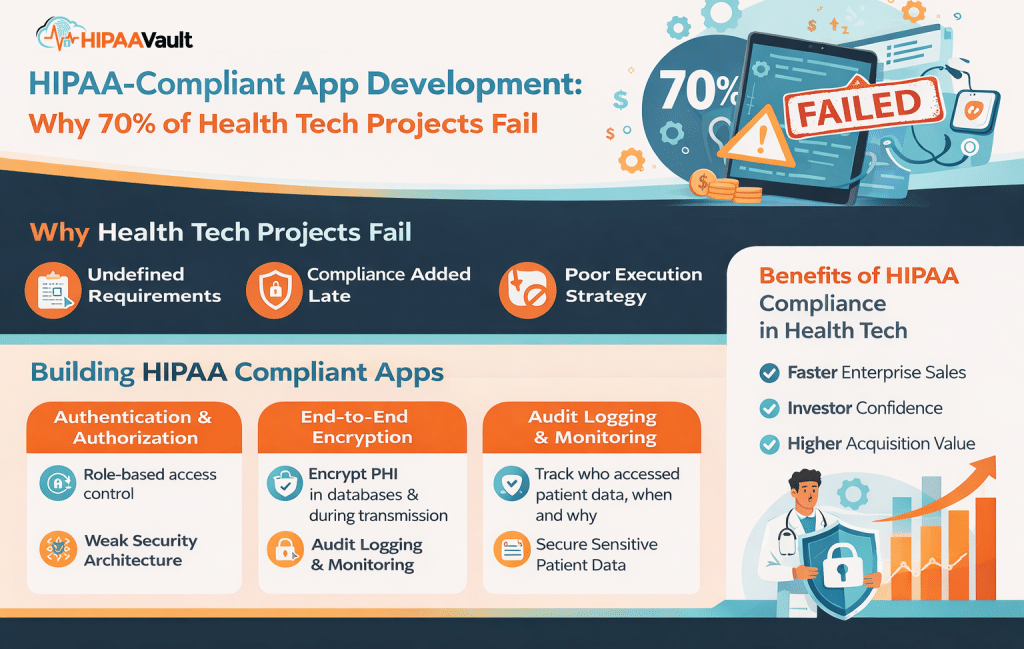
Several common issues cause healthcare software projects to fail.
Lack of Clear Requirements
Many startups jump directly into development without clearly defining workflows, users, or compliance needs. This leads to wasted development cycles and incomplete products.
Compliance Added Too Late
Security requirements should be integrated during the architecture phase. Adding compliance later can require significant redesigns.
Weak Technical Foundations
Healthcare platforms must support:
- secure authentication
- protected data storage
- compliant infrastructure
- scalable architecture
Without these elements, systems often require expensive rebuilds.
According to the National Institute of Standards and Technology (NIST), security controls should be integrated throughout the software development lifecycle—not added after deployment.
→ Launching a healthcare platform?
Explore secure infrastructure built specifically for healthcare startups with HIPAA Vault Compliant Hosting
What Developers Must Do for HIPAA-Compliant App Development
Many companies assume that HIPAA compliance is mostly about servers and infrastructure. While infrastructure is important, it’s only part of the equation.
Mansoor explains:
“Infrastructure is important, but it’s just the foundation. The bigger part of building a HIPAA-compliant application is how you code it.”
Healthcare applications must implement several critical safeguards.
Authentication and Authorization
Applications must control exactly who can access sensitive health information.
Security best practices include:
- role-based access control
- multi-factor authentication
- session expiration policies
- permission-based workflows
These safeguards prevent unauthorized access to patient data.
Encryption of Patient Data
Protected Health Information must be encrypted in several environments:
- during transmission (TLS encryption)
- while stored in databases
- on mobile devices
- within user sessions
Encryption ensures patient data remains secure even if infrastructure is compromised.
Audit Logging and Monitoring
Audit logging is a core requirement for healthcare applications.
Every interaction involving patient data should be recorded, including:
- who accessed the data
- when it was accessed
- what information was viewed
- any modifications made
These logs help organizations detect breaches and demonstrate compliance during audits.
→ Not sure if your platform meets HIPAA requirements?
Schedule a Free HIPAA Risk Assessment
Identify compliance gaps before they become costly problems.
Why Compliance Should Start on Day One
Many startups treat compliance as something to worry about later.
That approach usually backfires.
Mansoor explains:
“Compliance only slows you down when it’s bolted on late. When it’s designed into workflows early, it actually accelerates scale.”
Designing compliance early provides major advantages.
Faster Enterprise Sales
Healthcare organizations often require vendors to complete detailed security questionnaires before purchasing software.
If a product is not compliant, deals frequently stall.
Higher Investor Confidence
Investors see compliance readiness as a signal of lower risk and stronger governance.
Reduced Development Rework
Adding compliance late can require major changes to:
- databases
- APIs
- application architecture
Building securely from the start avoids these expensive rebuilds.
→ Build your healthcare platform on a compliant cloud environment
Explore secure hosting built for healthcare applications:
How AI Is Changing HIPAA-Compliant Healthcare Software
Artificial intelligence is becoming increasingly common in healthcare platforms. However, integrating AI into healthcare systems requires strict safeguards to protect patient data.
Mansoor highlights a key risk:
“You want to make sure PHI data is not shared with any AI provider for training.”
Healthcare companies using AI must ensure that vendors handling PHI sign Business Associate Agreements (BAAs).
The U.S. Department of Health and Human Services requires BAAs whenever third-party vendors process protected health information.
Secure AI architectures also ensure that only the necessary information is shared with AI systems.
→ Running AI workloads with sensitive health data?
Talk to a HIPAA Vault infrastructure specialist
Why HIPAA Compliance Builds Trust in Health Tech
Healthcare organizations must protect patient data, which makes security one of the most important factors when evaluating technology vendors.
Mansoor explains what often happens when compliance is missing:
“The moment you say it’s not HIPAA compliant, the reluctance starts immediately.”
Strong compliance practices increase:
- customer trust
- enterprise adoption
- investor confidence
- acquisition value
For healthcare startups, security is not just a legal requirement—it’s a competitive advantage.
Final Thoughts
Healthcare technology has the potential to transform patient care, but innovation must always be paired with strong security practices.
Organizations that build compliance directly into their software development process can:
- protect patient data
- accelerate enterprise adoption
- reduce development risk
- increase company valuation
→ Planning a healthcare SaaS or mobile application?
Start with secure infrastructure designed for healthcare innovation.
Request a Free Consultation or explore HIPAA-compliant solutions.