
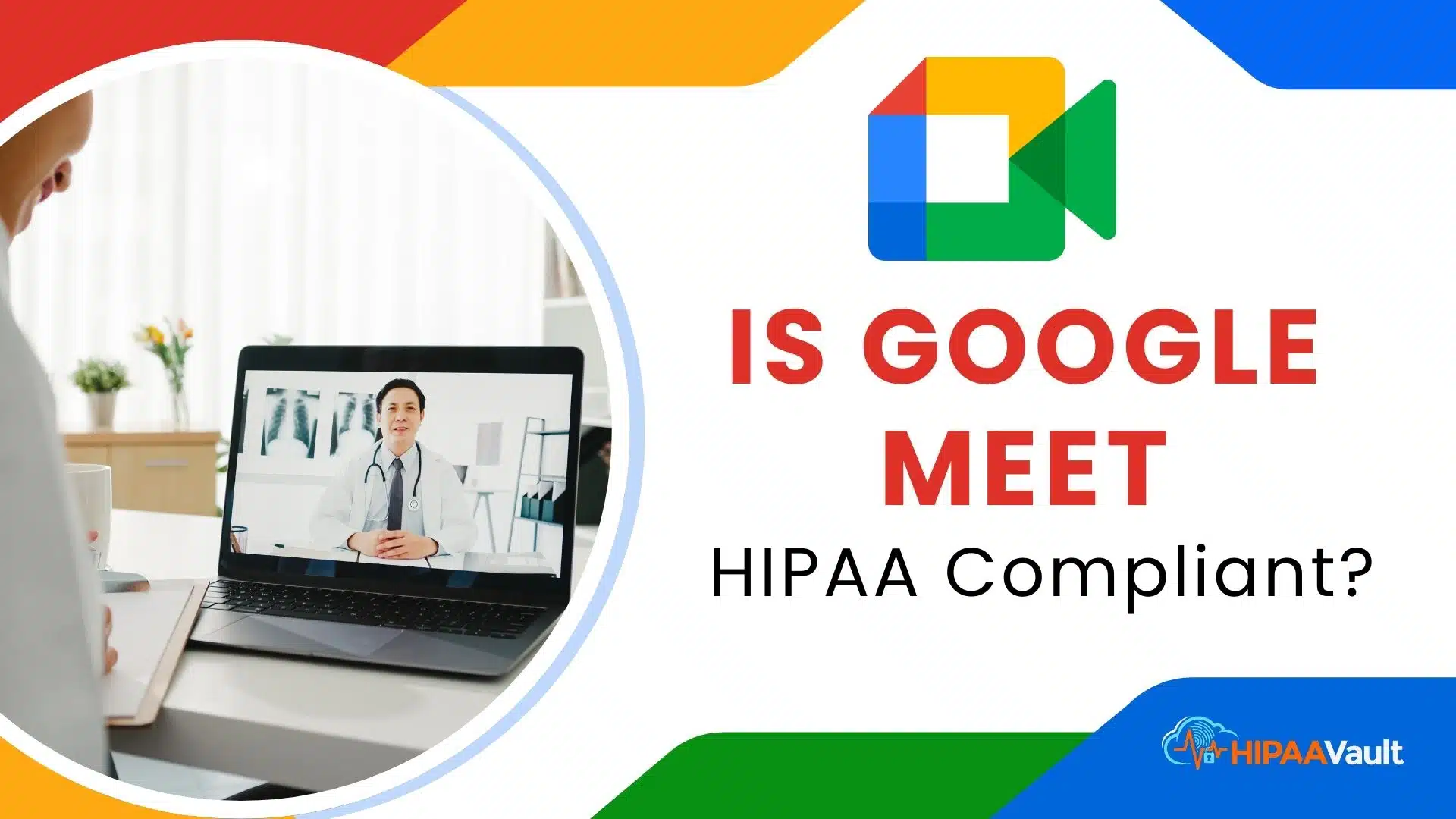
Healthcare organizations increasingly rely on video conferencing for Telehealth visits, internal collaboration, and patient communication. This raises a critical compliance question: is Google Meet HIPAA compliant?
The short answer is no — not by default.
Google Meet can be used in a HIPAA-compliant way, but only under specific conditions that many healthcare organizations misunderstand or fail to implement correctly.
This guide explains:
- When Google Meet is allowed under HIPAA
- Whether Google provides a HIPAA Business Associate Agreement (BAA)
- How to make Google Meet HIPAA compliant
- The risks Google doesn’t manage for you
- Safer alternatives for healthcare communication
If you’re already using Google Meet with PHI, HIPAA Vault can review your Google Workspace setup for you and identify compliance gaps before they become reportable incidents.
→ Have HIPAA Vault assess your Google Meet usage
What HIPAA Requires for Video Conferencing Tools
HIPAA does not approve or certify software. Instead, it requires covered entities and business associates to implement administrative, physical, and technical safeguards when electronic protected health information (ePHI) is created, transmitted, or stored.
HIPAA Privacy Rule Requirements
Any video conferencing tool used with patients must:
- Limit use and disclosure of PHI
- Prevent unauthorized access to conversations
- Protect patient privacy during virtual encounters
HIPAA Security Rule Safeguards (Technical Focus)
Under the HIPAA Security Rule, organizations must implement:
- Unique user identification and access controls
- Encryption of ePHI in transit
- Audit controls
- Transmission security
- Ongoing risk management
According to HHS, video communication platforms used in healthcare are subject to HIPAA requirements just like any other system that handles ePHI.
(HHS Telehealth & HIPAA Guidance)
Technology alone does not create compliance. Configuration, policies, training, and contracts all matter.
Is Google Meet HIPAA Compliant for Healthcare Use?
When Google Meet Can Be HIPAA Compliant
Google Meet may be used in a HIPAA-compliant manner only if all of the following conditions are met:
- You use Google Workspace (not free Gmail or personal Google accounts)
- You have a signed Business Associate Agreement (BAA) with Google
- Google Meet is properly configured with restricted access
- Meetings are not shared publicly or reused improperly
- Staff are trained on HIPAA-safe usage
- A formal HIPAA Security Risk Assessment has been completed
If any of these are missing, Google Meet is not HIPAA compliant, even if encryption is enabled.
Stop Guessing. We Validate Your Google Meet Compliance.
HIPAA risk isn’t theoretical — it comes from real misconfigurations.
→ Get a HIPAA Risk Assessment Handled by our Experts
We review your Google Workspace and document compliance gaps.
When Google Meet Is Not HIPAA Compliant
Google Meet is not HIPAA compliant if:
- You use free or personal Google accounts
- No BAA is in place
- Meeting links are publicly accessible
- Recordings are stored insecurely
- Staff are not trained on HIPAA requirements
Most compliance failures tied to video tools occur due to human error, not platform failure.
Does Google Offer a HIPAA Business Associate Agreement (BAA)?
Yes — but only for paid Google Workspace customers.
Google will sign a BAA that covers certain Workspace services, including Google Meet, only when:
- The account is properly licensed
- Covered services are enabled
- Administrators enforce security controls
HIPAA requires a Business Associate Agreement whenever a vendor handles PHI on behalf of a covered entity.
Important:
A BAA does not make you HIPAA compliant. It only defines Google’s responsibilities — you remain responsible for configuration, access control, and risk management.
Is Google Meet HIPAA Compliant for Telehealth?
Google Meet can be used for telehealth, but it was not designed as a healthcare-first platform.
Limitations include:
- No built-in patient identity verification
- No consent management
- No HIPAA-specific audit reporting
- No healthcare workflows
Because of this, Google Meet is typically used for low-risk virtual check-ins, not full telehealth programs handling large volumes of PHI.
Many organizations supplement Meet with:
What Google Meet Does Not Do for HIPAA Compliance
This is where risk is often misunderstood.
Google Meet does not:
- Enforce HIPAA policies
- Prevent staff mistakes
- Manage patient consent
- Monitor compliance violations
- Replace a HIPAA risk assessment
Encryption alone does not satisfy HIPAA Security Rule requirements for access control and auditing.
HIPAA compliance is a shared responsibility, and most exposure exists on the customer side — not Google’s.
Stop Using Personal Gmail for Patient Data
It’s a violation to use standard Gmail. Upgrade to our managed Workspace solution to ensure data privacy.
Learn MoreHow to Make Google Meet HIPAA Compliant
If your organization chooses to use Google Meet, you should:
- Sign a Google Workspace BAA
- Restrict meetings to authenticated users
- Disable unauthorized recordings
- Enforce strong authentication and access controls
- Train staff on HIPAA-safe video usage
- Conduct a formal HIPAA Security Risk Assessment
Google Meet does not manage HIPAA compliance for you.
It does not control how PHI is shared outside the meeting, how users access sensitive data, or how safeguards are enforced across your environment.
That’s why many healthcare organizations reduce risk by pairing Google Meet with HIPAA-compliant infrastructure designed to protect PHI before, during, and after a video call:
✔ HIPAA-Compliant Email for patient communication
✔ Secure HIPAA Hosting for PHI storage and applications
✔ Access controls designed specifically for PHI—not consumer tools
Pros and Cons of Using Google Meet for HIPAA-Regulated Communication
Pros
- Familiar interface
- Easy to deploy
- Encryption in transit
- BAA available with paid plans
Cons
- Not healthcare-native
- Compliance depends heavily on configuration
- Limited HIPAA-specific auditing
- High risk of accidental violations
- No built-in enforcement controls
Safer HIPAA-Compliant Alternatives for Healthcare Communications
Organizations with higher compliance risk often choose HIPAA-specific platforms that provide:
- Enforced access controls
- Secure messaging and file handling
- Clear audit trails
- Reduced human error
Many providers use a hybrid approach:
- Google Meet for internal meetings
- HIPAA-compliant tools for patient communications
Final Verdict: Should Healthcare Providers Use Google Meet?
Google Meet is not inherently HIPAA compliant.
It can be used compliantly — but only with:
- A signed BAA
- Proper configuration
- Staff training
- Ongoing risk management
For organizations that want lower risk and clearer safeguards, HIPAA-specific communication solutions are often the safer choice.
Frequently Asked Questions (FAQ)
If OCR Asked Tomorrow, Could You Defend Your Google Meet Usage?
Most healthcare organizations cannot clearly document:
- Why Google Meet was selected for PHI-related communication
- How access is restricted and monitored
- Where PHI risk exists across email, meetings, storage, and users
- What safeguards are in place outside the video call
That’s exactly what regulators ask after an incident.
How HIPAA Vault Helps You Defend It
HIPAA Vault helps healthcare organizations assess, fix, and defend their Google Workspace and telehealth environments.
We do this by:
- Conducting a HIPAA Security Risk Assessment
- Identifying Google Meet and Workspace misconfigurations
- Providing HIPAA-compliant email and secure hosting
- Reducing PHI exposure across users, files, and communications
- Delivering audit-ready documentation you can stand behind
→ Work With HIPAA Vault to Secure Your Google Meet Usage
Request a HIPAA Risk Assessment
Built for Google Workspace, Telehealth, and real-world healthcare workflows.