
Something big is happening in healthcare.
Clinicians, founders, and even non-technical practice owners are now building full-scale applications using AI coding tools—patient portals, intake systems, remote monitoring dashboards—all in a matter of days.
But here’s the problem: just because your app works doesn’t mean it’s a HIPAA compliant healthcare app.
In fact, most aren’t.
Before you deploy anything that touches patient data, there’s a critical gap you need to understand—and fix.
→ Request a Free Consultation with an expert
Quick 15-minute call. Trusted by 1,000+ healthcare organizations.
Why Your AI-Built Healthcare App Isn’t HIPAA Compliant
AI coding tools like Replit, Cursor, and Bolt are incredibly powerful. They allow domain experts—like clinicians—to build tools that actually reflect real-world workflows.
That’s the good news.
The bad news?
Most AI-generated healthcare apps are missing the core security requirements needed for HIPAA compliance, including:
- Weak or missing authentication systems
- No encryption for PHI (Protected Health Information)
- Incomplete role-based access controls
- No audit logging or monitoring
- Poor input validation
These risks closely align with the OWASP Top 10 application security risks
And according to the NIST Cybersecurity Framework applications must implement continuous monitoring, strict access control, and risk management—areas where AI-generated apps often fall short.
These apps may function well initially—but expose serious vulnerabilities as they scale.
Accelerate Innovation with Managed Google Cloud AI
Build custom models using TensorFlow and Document AI. We handle the security and BAA, giving you total control over your results.
Learn MoreThe Biggest Myth: HIPAA Hosting = HIPAA Compliance
This is where most founders get it wrong.
They assume that deploying their app on a HIPAA-compliant server automatically makes their application compliant.
It doesn’t.
Not even close.
Here’s the distinction:
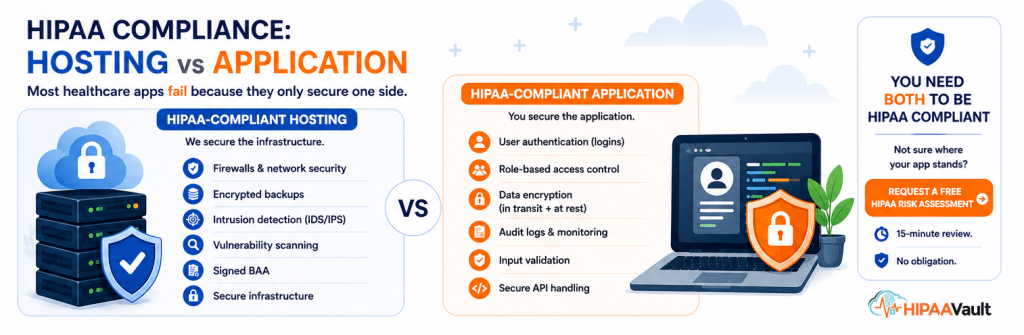
HIPAA-compliant hosting secures infrastructure:
- Firewalls
- Encrypted backups
- Intrusion detection
- Vulnerability scanning
- Signed BAA
A HIPAA compliant healthcare app secures the application layer:
- Authentication logic
- Data handling
- Access controls
- Audit logging
HIPAA itself enforces these safeguards under the HIPAA Security Rule
Think of it like this:
Your hosting provider secures the building—but you’re still responsible for what happens inside it.
→ Get a HIPAA Hosting Quote
Fully managed infrastructure with BAA included—ready in days, not months.
Who This Impacts Most
App Developers & Founders
You built something real. Now you need to deploy it safely.
Without compliant infrastructure, your app can’t handle patient data securely.
→ Explore HIPAA Cloud Hosting
Isolated environments. Full control. Built for healthcare apps.
Agencies & Web Developers
If a client’s app gets breached, your guidance is part of the risk.
Saying “you’re compliant” because of hosting alone is a liability.
→ Secure every client site under one managed environment with HIPAA Compliant WordPress Hosting
Practice Owners
You just want your system to work—without creating a compliance nightmare.
If your tool handles patient data, you need:
- Secure infrastructure
- A signed BAA
- Continuous monitoring
How to Turn Your App Into a HIPAA Compliant Healthcare App
There’s a clear, proven path from MVP to compliance.
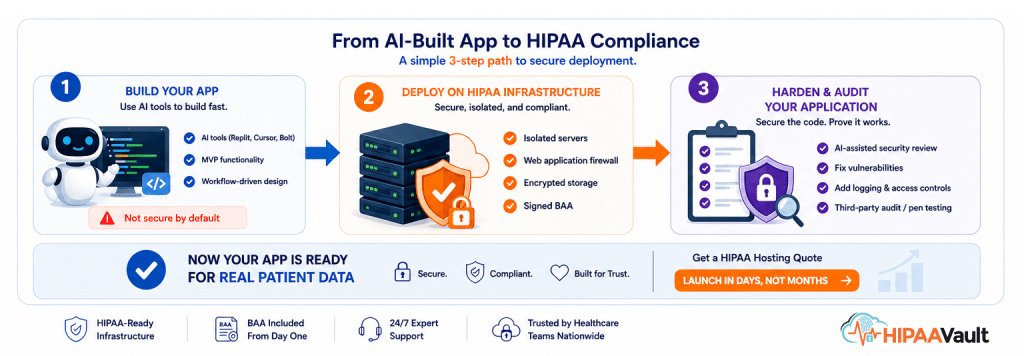
Step 1: Discovery & Architecture
Understand your:
- Tech stack
- Database
- APIs
- File storage
Step 2: Secure Infrastructure Deployment
Deploy into:
- Isolated servers
- Web application firewall
- Encrypted storage
- BAA-backed environment
Step 3: Go Live with Ongoing Protection
Maintain:
- Vulnerability scanning
- Intrusion detection
- Encrypted backups
- 24/7 monitoring
→ Schedule a Free HIPAA Risk Assessment
Identify compliance gaps before they become liabilities.
Fixing the Code Problem: AI Can Help—But Carefully
AI created the problem—but it can also help fix it.
Modern developers are now using:
- AI-generated security guardrails
- Automated vulnerability scans
- Structured compliance prompts
This aligns with the Secure Development Lifecycle (SDL); you should also benchmark your app against the OWASP Top 10 to identify common vulnerabilities.
Eventually, you’ll still need:
- Third-party audits
- Penetration testing
→ Schedule a Free HIPAA Risk Assessment
Identify compliance gaps before they become liabilities.
Why HIPAA Vault Is Built for This New Era
HIPAA Vault is purpose-built for healthcare compliance.
With over two decades serving the industry, they provide:
- Fully managed HIPAA infrastructure
- Signed BAAs from day one
- Isolated environments
- Continuous monitoring + SIEM logging
- <15 minute support response
→ Get a Custom Quote
Free migration. No downtime. Trusted by healthcare teams nationwide.
Frequently Asked Questions
AI has made it easier than ever to build healthcare applications.
But it hasn’t made compliance any easier.
To create a truly HIPAA compliant healthcare app, you need:
- Secure infrastructure
- Hardened application code
- Continuous monitoring
The builders who understand this lifecycle will scale.
Everyone else is taking a risk.
→ Start Your HIPAA Compliance Journey
No pressure. Just clarity on what your app needs to go live safely.