
Healthcare organizations spend millions defending themselves against ransomware, phishing campaigns, and external cyberattacks. But one of the most dangerous threats in modern healthcare security may already have authorized access to sensitive data.
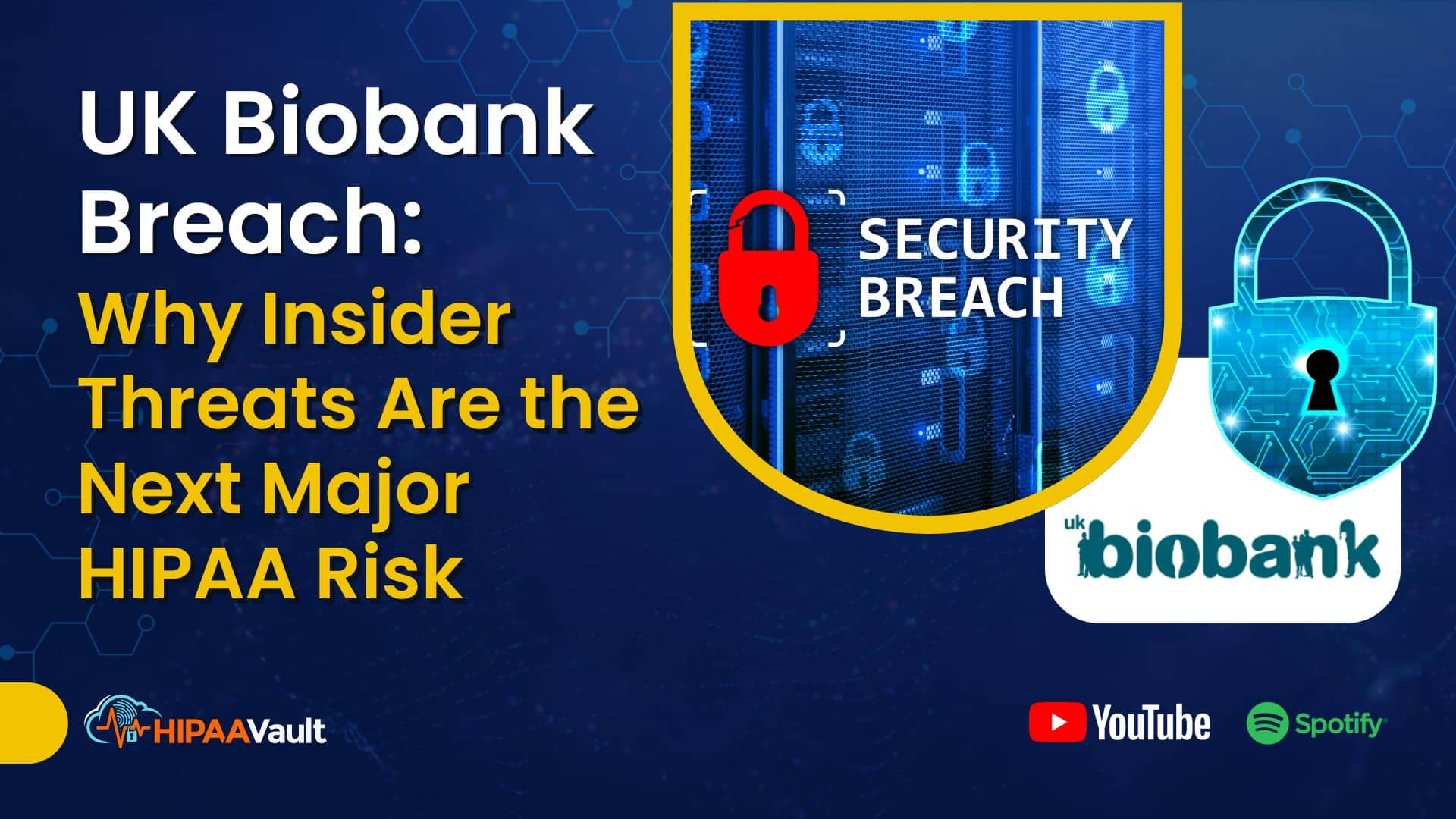
The recent UK Biobank breach is a powerful reminder that insider threats are becoming one of the biggest cybersecurity and compliance risks facing healthcare organizations worldwide. According to the UK Biobank official participant update, listings offering access to UK Biobank data were found on a Chinese consumer website owned by Alibaba. A UK government statement to Parliament also confirmed that UK Biobank notified the government after discovering the data had been advertised for sale on Alibaba e-commerce platforms.
Unlike traditional breaches involving malware or stolen credentials, this incident was not primarily described as an outside cyberattack. Public reporting indicates the data had been accessed through legitimate research channels before being offered for sale online. That is exactly why the incident matters for HIPAA-covered entities, business associates, healthcare research organizations, and cloud vendors in the United States.
In a recent episode of the HIPAA Insider Show podcast, we discussed what happened, why it matters for HIPAA compliance, and how healthcare organizations can better protect sensitive data from both external attackers and trusted insiders.
→ Concerned about insider threat exposure or vendor risk?
Request a Free HIPAA Security Assessment and identify potential gaps before they become reportable incidents.
Key Takeaways
- The UK Biobank breach was reportedly caused by misuse of authorized research access rather than a traditional cyberattack.
- Insider threats are becoming one of the biggest healthcare cybersecurity risks for HIPAA-covered entities and business associates.
- De-identified healthcare data may still carry re-identification risks when combined with external datasets.
- Healthcare organizations should strengthen data governance, least privilege access, monitoring, and vendor oversight.
- Trusted Research Environments (TREs) may become a critical future safeguard for healthcare research security.
- AI-driven healthcare analytics are increasing the value — and risk — of healthcare research data.
According to IBM’s 2025 Cost of a Data Breach Report, healthcare remained the most expensive industry for breaches globally, with average breach costs exceeding $10 million per incident. Verizon’s 2025 Data Breach Investigations Report also found that insider-related incidents and misuse of authorized access continue to play a major role in modern breach activity.
What Happened in the UK Biobank Breach?
According to The BMJ, medical details from approximately 500,000 UK Biobank participants were discovered for sale on Alibaba, including gender, age, month and year of birth, socioeconomic status, lifestyle habits, mental health information, self-reported medical history, cognitive function, and physical measures.Other sources also reported that the data was originally accessed legitimately by three Chinese research institutions, whose access was later revoked.
The key point is that this was not described as a ransomware attack, malware incident, or firewall failure. Instead, the UK government’s statement framed the issue around data being advertised for sale after UK Biobank had provided access to accredited researchers.
That distinction matters.
For HIPAA-covered entities, the closest equivalent would be a business associate, contractor, researcher, analytics partner, or vendor misusing authorized access to sensitive healthcare information.
Why This Matters to HIPAA-Covered Entities
Although the UK Biobank breach occurred outside the United States, the security lesson is directly relevant to HIPAA compliance.
HIPAA-covered entities routinely share protected health information with business associates, cloud providers, billing vendors, analytics firms, research organizations, and other third parties. The HHS HIPAA Security Rule requires covered entities and business associates to implement administrative, physical, and technical safeguards to protect electronic protected health information.
But safeguards cannot stop at the perimeter.
Insider threats often involve people or organizations that already have:
- Valid credentials
- Approved access
- Contractual permission
- Trusted relationships
- Legitimate business reasons to interact with data
That makes them harder to detect than many external attacks.
A signed Business Associate Agreement is important, but it is not a complete security strategy. Healthcare organizations must also validate whether vendors and partners maintain practical controls such as access logging, data loss prevention, audit trails, user behavior monitoring, and egress restrictions.
→ Is Your Cloud Environment Ready for Insider Threats?
If sensitive healthcare data lives in the cloud, access control is only the beginning. HIPAA Vault helps organizations strengthen least privilege, segmentation, monitoring, and HIPAA-aligned governance before data leaves your control.
Explore HIPAA-Compliant Cloud Hosting
Why De-Identified Data Is Still Dangerous
One of the most important discussions surrounding the UK Biobank breach involves the limits of de-identification.
UK Biobank stated in its official security update that the listings did not contain personally identifying information. However, de-identified healthcare data can still create risk when combined with external datasets.
The HHS guidance on de-identification explains that de-identification depends on whether there is a very small risk that information could be used, alone or in combination with other reasonably available information, to identify an individual.
This is often called the mosaic effect.
For example, combining data points such as birth year, demographic details, lifestyle information, public records, and geographic indicators may increase re-identification risk. As AI-driven analytics become more advanced, healthcare organizations should assume that de-identification reduces risk but does not eliminate the need for governance.
Ready for the 2026 HIPAA Rules
See the fully managed solutions that meet MFA, encryption, and recovery requirements out of the box
See HIPAA SolutionsHealthcare Security Is Shifting From Perimeter Defense to Data Governance
For years, healthcare cybersecurity focused heavily on perimeter defense: firewalls, antivirus tools, intrusion prevention, and endpoint protection.
Those controls remain essential, but modern healthcare threats increasingly involve trusted users operating inside authorized environments. The UK Biobank incident reinforces why healthcare organizations need to know not only who has access to data, but also what they do with it after access is granted.
This shift aligns with the NIST Cybersecurity Framework, which emphasizes identifying, protecting, detecting, responding to, and recovering from cybersecurity risks. Healthcare organizations can also use NIST SP 800-53 security controls to structure stronger access control, audit, monitoring, and data protection programs.
The future of healthcare cybersecurity is no longer just about blocking attackers. It is about controlling how trusted users interact with sensitive information.
Why Healthcare Research Data Is Becoming a Major Insider Threat Target
Healthcare research datasets are becoming extraordinarily valuable because they often contain genomic information, clinical histories, biological measurements, longitudinal health records, and data useful for AI model development.
That value creates risk.
As The Independent reported, the UK Biobank breach raised concerns about public trust in large-scale medical research programs. If participants believe their data may be mishandled, research institutions may face reputational harm that extends beyond a single incident.
This matters for healthcare AI, precision medicine, and research collaboration. These fields depend on large, high-quality datasets. If governance fails, so does public trust.
5 Security Controls That Could Help Prevent Similar Incidents
The UK Biobank incident highlights why healthcare organizations must adopt stronger data governance and insider threat controls.
Here are five security strategies that can significantly reduce risk exposure.
1. Trusted Research Environments (TREs)
Trusted Research Environments may represent the future of healthcare research security.
Rather than distributing raw datasets directly to researchers, TREs bring researchers into tightly controlled environments where the data remains protected. UK Biobank said in its official update that it is taking additional actions in response to the incident, including stronger restrictions and monitoring around data access.
TREs commonly include:
- Isolated cloud environments
- Secure virtual desktops
- Download restrictions
- Disabled copy/paste functionality
- Session monitoring
- Granular access controls
This dramatically reduces the risk of unauthorized data exfiltration.
→ Build a Safer Home for Healthcare Data
Modern healthcare infrastructure needs more than storage — it needs controlled access, continuous oversight, and HIPAA-ready safeguards built in from the start.
Explore HIPAA Hosting Solutions
2. Digital Watermarking
Digital watermarking embeds traceable identifiers into exported datasets.
If sensitive data later appears online or on unauthorized marketplaces, organizations may be able to identify which user, institution, or export event was associated with the leaked information.
This improves accountability, strengthens forensic investigations, and may deter intentional misuse.
3. Egress Monitoring and Data Loss Prevention
Healthcare organizations should monitor not only who accesses data, but how data leaves the environment.
Data Loss Prevention systems can detect abnormal downloads, flag unusual transfer behavior, block unauthorized exports, monitor outbound email attachments, and identify suspicious data movement patterns.
The HHS guidance on HIPAA risk analysis emphasizes the importance of identifying where electronic protected health information is created, received, maintained, or transmitted. That same principle applies to insider threat prevention: organizations must understand how sensitive data moves.
→ Find the Gaps Before Attackers—or Insiders—Do
Visibility gaps can leave sensitive healthcare data exposed. HIPAA Vault penetration testing helps uncover weaknesses in access controls, monitoring, and cloud security before they become compliance risks.
Explore HIPAA Penetration Testing
4. Synthetic Data for Research
Synthetic data is becoming increasingly valuable in healthcare research and AI development.
Rather than exposing real patient records during early-stage research or testing, organizations can use statistically realistic artificial datasets that preserve useful patterns without exposing actual individuals.
Synthetic data is not appropriate for every use case, but it can reduce unnecessary exposure of real patient information.
5. Institutional Accountability and Governance
Insider threats are not solely technical problems. They are governance problems.
Healthcare organizations must implement vendor oversight, research approval controls, access reviews, executive accountability, legal enforcement mechanisms, and security awareness training.
Without strong governance, even advanced technical controls may fail.
What HIPAA Organizations Should Do Right Now
The UK Biobank breach should serve as a wake-up call for healthcare organizations handling sensitive information.
Healthcare leaders should immediately review whether their existing security strategies adequately address insider threat exposure.
Audit Business Associates
Move beyond the signed BAA. Ask vendors detailed questions about insider threat monitoring, access logging, DLP controls, behavioral analytics, incident response, and data governance policies.
Enforce Least Privilege Access
Users should only have access to the minimum data necessary to perform their responsibilities. Excessive permissions significantly increase organizational risk.
Monitor Data Egress
Organizations should actively monitor outbound data movement and unusual transfer behavior. Large downloads and abnormal export patterns should trigger automated alerts.
Conduct Regular Risk Assessments
Insider threat risks often remain hidden until after a breach occurs. The HHS HIPAA risk analysis guidance makes clear that risk analysis is foundational to identifying vulnerabilities and implementing appropriate safeguards.
→ Need help evaluating insider threat risks, data egress, or business associate exposure?
Schedule a HIPAA Risk Assessment with HIPAA Vault.
Final Thoughts
The UK Biobank breach demonstrates a difficult truth about modern healthcare cybersecurity: some of the greatest risks come from trusted insiders, not anonymous hackers.
As healthcare organizations continue adopting cloud infrastructure, AI analytics, and large-scale research collaboration, insider threat prevention will become increasingly important to HIPAA compliance and patient trust.
Healthcare organizations can no longer focus solely on keeping attackers out. They must also control how trusted users interact with sensitive data.
Organizations that invest in data governance, least privilege access, monitoring, secure research environments, vendor oversight, and insider threat detection will be far better positioned to prevent the next major healthcare data scandal.
→ Concerned about insider threats, business associate exposure, or healthcare data governance?
Contact HIPAA Vault to discuss secure infrastructure, monitoring, and HIPAA compliance strategies.